What Temperature Should Your Water Heater Be Set To?
The default factory setting is 140F but the DOE recommends 120F. Here is why the difference matters for safety and savings.

May 9, 2026
Safety Disclaimer
Water heater maintenance involves working with pressurized systems, scalding hot water, and potentially hazardous electrical or gas connections. Always shut off power (electric heaters) or gas supply (gas heaters) and allow water to cool to a safe temperature before beginning any maintenance. Wear appropriate safety equipment including gloves and eye protection. If you're uncomfortable with any step, contact a licensed plumber.
Unique angle here: the two-camp list (120 vs 140) without the long energy table. The longer balance argument is Water Heater Temperature Settings: Finding the Right Balance.
Desk note: The 120°F recommendation, the “about 3–5 percent per 10°F” energy language, and the scald-time figures below come from Energy.gov, published burn-time tables (CPSC / burn-prevention literature), and Legionella guidance (OSHA / CDC style). This desk did not run a calorimeter or a pathogen lab. Dollar savings are research-range illustrations, not a bill from your utility.
Most tanks leave the factory near 140°F. Most households never measure the tap. The useful first move is a glass of hot water and a probe, not a guess at the dial.
Before You Turn the Dial
- Measure the tap, then the dial. Run the hot faucet closest to the heater for two to three minutes. Fill a glass. Read it with an instant-read probe. The Taylor Precision waterproof thermometer is a liquid probe with a °F scale — that is the buying note. A grill infrared gun reads the glass, not the water.
- Note who uses the showers. Children, older adults, and anyone with reduced sensation change the scald conversation. A 140°F tank plus a missing mixing valve is a different risk than a 120°F tank in an adult-only house.
- Note the dishwasher. Post-2010 dishwashers usually have a booster. An older unit without one is the usual reason people stay near 140°F.
- Note hardness. Scale forms faster at higher tank temperatures. If the tank already pops or the first draw is cloudy, pair this page with how hard water destroys a water heater before you raise the dial to “get more hot water.”
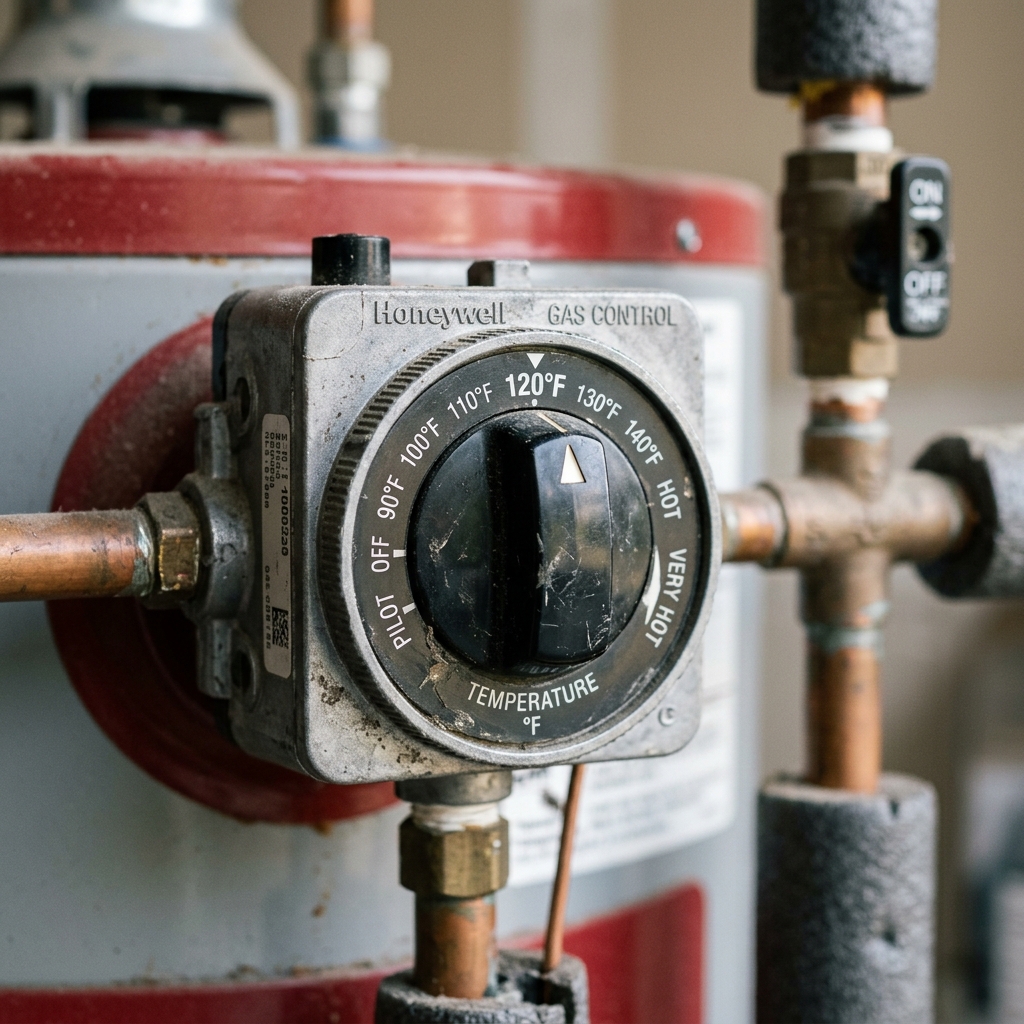
- Then adjust. Gas: dial on the control valve. Electric: breaker off, both thermostats, same number. Details below.
Listing check (setpoint thermometer): confirm it is an instant-read food or liquid probe with a °F scale, not a grill-only infrared gun and not a pool tester sold on the same search page.
If the water at the tap is already over 140°F with the dial in the middle, stop shopping for a blanket. That is a thermostat or element problem — see hot water heater not working and water heater thermostat adjustment.
The Two Camps
120°F (Department of Energy Recommendation)
- Lowers scald risk compared with a factory 140°F tank
- Energy.gov language: roughly 3–5 percent water-heating energy per 10°F you drop the setpoint (so 140→120 is often discussed as about 6–10 percent). Treat that as published guidance, not a guarantee on your bill.
- Slows mineral precipitation in hard water relative to a hotter tank
- Enough for most household washing and showers when the tank is healthy
140°F (Factory Default on Most Heaters)
- Kills Legionella faster than 120°F (published kill-time tables, not a test from this desk)
- Leaves more temperature after pipe heat loss on a long run
- Helps older dishwashers that lack a booster
- Common in commercial code conversations; residential houses still have to manage scald risk at the tap
For the longer energy table and the 110–160°F risk grid, use Water Heater Temperature Settings: Finding the Right Balance.
The Scalding Risk
Published burn-prevention tables put 140°F water in the “seconds, not minutes” range for a serious burn, and 120°F in the “minutes of contact” range. Those are literature figures, not a staged burn test. They are why this site treats 140°F storage plus a bathroom without a mixing valve as a safety problem, especially with kids or older adults.
Whole-house hazards, including T&P discharge and gas, are in water heater safety.
If you keep the tank at 140°F for Legionella or a long recirculation loop, the usual mitigation is a mixing (tempering) valve at the point of use so the tap is closer to 120°F. That is a plumbing part, not a tank setting.
The Legionella Consideration
Legionella can grow in lukewarm water. OSHA / CDC-style guidance puts the growth band in the high-70s to low-110s °F. At 120°F growth is slowed; at 140°F published kill times are measured in minutes. This desk is not claiming a household infection rate.
For most healthy households, Energy.gov still points at 120°F. For immunocompromised residents, or buildings with long unused pipe runs (guest baths, vacation homes), 140°F storage plus mixing valves at the tap is the combination the same literature discusses. A vacant house that will freeze is a drain job, not a temperature-dial job — see how to winterize a water heater.
How to Check Your Current Setting
- Run hot water from the tap closest to the water heater for 2-3 minutes.
- Fill a glass and measure the temperature with a cooking thermometer.
- Compare to the thermostat setting on the heater.
A 10°F gap between dial and glass is common. Pipe run, a mixing valve already installed, and a tired thermostat all move the number. Believe the glass.
How to Adjust
- Gas heaters: Turn the dial on the gas valve. Most have marked temperature positions. Labels like Warm / Hot / Very Hot are not precision marks. Change one notch, wait until the tank recovers, measure again.
- Electric heaters: Turn off the breaker. Remove the access panels. Use a flathead screwdriver to adjust the thermostat. Electric heaters typically have two thermostats (upper and lower); set both to the same temperature. Restore the insulation and panels before the breaker goes back on.
Do not dry-fire an electric tank. If you drained it for other work, refill completely first — how to drain an electric hot water heater.
The Best Compromise
Set the tank to 120°F and add an anti-scald mixing valve if someone in the house cannot react quickly to hot water. If the dishwasher has no booster, 125°F is the usual half-step — still measure at the tap.
Raising the setpoint to stretch a small tank is the wrong lever. Size the heater with FHR and fixture math. A tank that cannot hold temperature may be scaled, short an element, or finished — 7 signs your water heater is about to fail.
Closed plumbing plus a hotter tank also dumps more expansion volume into the pipes. If a T&P drips on every heat cycle, read do you need an expansion tank before you replace the valve.
Related Guides
- Water Heater Temperature Settings: Finding the Right Balance
- Water Heater Thermostat Adjustment Guide
- Water Heater Safety: 7 Hazards Every Homeowner Should Know
- What Size Water Heater Do You Need?
- How Hard Water Destroys Your Water Heater
- 7 Signs Your Water Heater Is About to Fail
- Do You Need a Water Heater Expansion Tank?
- How to Flush a Water Heater
Sources
- U.S. Department of Energy, Water Heating
- OSHA, Legionella
- Published scald-time tables used in burn-prevention literature (CPSC / American Burn Association style)
Editorial Team
Nobody should pay a plumber $300 to turn a drain valve. Our guides are built from manufacturer documentation, plumbing code references, and the documented experience of homeowners and plumbers.