Gas vs. Electric Water Heater Maintenance: Key Differences
Gas and electric water heaters need different maintenance. Learn what to check on each type and which components are unique to each fuel source.

Jake Mitchell
January 9, 2025
Safety Disclaimer
Water heater maintenance involves working with pressurized systems, scalding hot water, and potentially hazardous electrical or gas connections. Always shut off power (electric heaters) or gas supply (gas heaters) and allow water to cool to a safe temperature before beginning any maintenance. Wear appropriate safety equipment including gloves and eye protection. If you're uncomfortable with any step, contact a licensed plumber.
Gas and electric water heaters both store and heat water in an insulated tank. They share several maintenance tasks in common, like flushing sediment and inspecting the anode rod. But each fuel type has components the other doesn’t, and those components come with their own maintenance requirements.
Knowing which tasks apply to your heater keeps you from wasting time on irrelevant checks and helps you stay on top of the maintenance that actually matters.
What They Share
Before covering the differences, here’s what every tank-style water heater needs, regardless of fuel source:
| Task | Frequency | Why It Matters |
|---|---|---|
| Flush sediment | Every 6-12 months | Removes mineral deposits that reduce efficiency |
| Inspect anode rod | Every 2-3 years | Prevents internal tank corrosion |
| Test T&P relief valve | Annually | Verifies the safety valve opens and seats properly |
| Check for leaks | Monthly (visual) | Catches drips before they become floods |
| Check outlet temperature | Annually | Confirms thermostat accuracy (should read 120°F) |
These tasks are identical for gas and electric units. The differences start when you look at how each type generates heat.
Gas Water Heater Maintenance
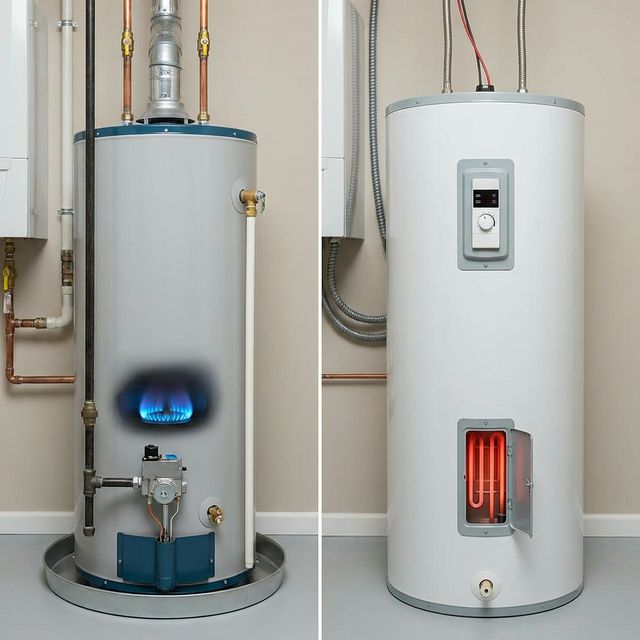
Gas water heaters use a burner assembly beneath the tank to heat water. Natural gas or propane flows through a gas line to the burner, where it combusts. Exhaust gases exit through a flue pipe or power vent. This system creates several maintenance points that electric heaters don’t have.
Burner Assembly Inspection
The burner sits inside a combustion chamber at the bottom of the water heater. Over time, dust, lint, and debris can clog the burner ports, causing uneven flame patterns or ignition problems.
How to check it:
- Turn the gas control to “Off.”
- Remove the outer access panel and the inner combustion chamber cover (if applicable).
- Look at the burner. The flame should be blue with a slight yellow tip. A fully yellow or orange flame indicates incomplete combustion and requires cleaning or adjustment.
- Check for soot deposits around the burner area. Heavy soot means the air-fuel mixture is off.
Frequency: Inspect annually. Clean with compressed air or a soft brush if debris is present.
Flue and Venting
The flue pipe carries combustion exhaust from the water heater to the outside. A blocked or disconnected flue is a serious safety hazard because it can allow carbon monoxide to accumulate in your home.
What to check:
- Every section of the flue pipe is connected and properly secured.
- No visible corrosion, holes, or rust damage.
- The draft diverter at the top of the heater is seated correctly.
- The flue has a proper upward slope toward the exit point.
- No nests, debris, or obstructions at the termination point outside.
Draft test: Hold a lit match or incense stick near the draft diverter while the burner is running. The smoke should be drawn upward into the flue. If smoke blows outward or stalls, there’s a draft problem that needs professional attention.
Frequency: Inspect every time you service the water heater. This is a safety-critical check.
Thermocouple and Flame Sensor
The thermocouple (or thermopile, on some models) is a safety device that detects whether the pilot light is on. If the pilot goes out, the thermocouple signals the gas valve to shut off gas flow, preventing a gas leak.
Signs of a failing thermocouple:
- The pilot light won’t stay lit after releasing the control knob.
- The pilot goes out intermittently.
- The water heater shuts down unexpectedly.
Maintenance: The thermocouple tip should be in direct contact with the pilot flame. If it’s bent away or coated in soot, reposition or clean it. If cleaning doesn’t fix a failing pilot, the thermocouple likely needs replacement, which is a $10 to $20 part and a 15-minute DIY job on most models.
Gas Line and Connection Check
Check the gas supply line where it connects to the water heater for any signs of leaking. The simplest method is the soapy water test: mix dish soap with water, brush it onto each fitting, and look for bubbles. Bubbles mean gas is escaping.
If you ever smell gas near your water heater, stop what you’re doing, leave the area, and call your gas utility immediately. Do not flip any switches or create sparks.
Frequency: Check annually, or anytime you smell something unusual.
Combustion Air Supply
Gas burners need oxygen. If your water heater is in an enclosed closet or utility room, the space needs adequate ventilation. Building codes typically require two openings: one near the floor and one near the ceiling, each providing at least one square inch of opening per 1,000 BTU of heater input.
Blocked vents can lead to incomplete combustion, carbon monoxide production, and a condition called backdrafting, where exhaust gases are pulled back into the living space instead of exiting through the flue.
Check: Make sure vent openings aren’t blocked by storage, laundry, or other items.
Electric Water Heater Maintenance
Electric water heaters use resistive heating elements immersed directly in the water. Most residential models have two elements: an upper and a lower. There’s no combustion, no flue, and no gas line, which makes electric heaters simpler in some respects. But the electrical components have their own maintenance needs.
Heating Element Inspection
Electric heating elements can fail in a few ways:
- Burnout: The element breaks internally, producing no heat. This is common when elements are energized without being submerged in water.
- Scale coating: Minerals build up on the element surface, insulating it from the water and reducing heat transfer. The element still works, but it’s much less efficient.
- Grounding fault: A crack in the element sheath allows water to contact the internal wire, creating an electrical short that trips the breaker.
How to test:
- Turn off the breaker.
- Remove the access panel and peel back the insulation.
- Disconnect the wires from the element terminals.
- Use a multimeter set to resistance (ohms). A working 4,500-watt element should read around 12 to 13 ohms. An open reading (infinity) means the element is burned out. A reading to ground indicates a sheath failure.
Frequency: Test every 2 to 3 years, or whenever you notice a drop in heating performance.
Thermostat Calibration
Each heating element has its own thermostat. The upper thermostat is the master; it controls both elements and switches between them. The lower thermostat manages only the lower element.
Thermostats rarely fail outright, but they can drift out of calibration. A thermostat that reads 120 degrees but actually shuts off at 110 degrees will leave you with lukewarm water.
How to check:
- Power off the breaker.
- Remove the access panel.
- Check the current setting on the thermostat dial. Use a flat-head screwdriver to adjust if needed.
- For a more precise check, use a thermometer at the nearest hot water faucet after the tank has fully recovered. Compare the measured temperature to the thermostat setting.
Frequency: Check annually, especially if water temperature seems inconsistent.
High-Limit Reset Button
Electric water heaters have a high-limit safety switch (also called the ECO or reset button) on the upper thermostat. If the water temperature exceeds approximately 170 degrees Fahrenheit, this switch trips and cuts power to the elements.
If your electric water heater suddenly stops producing hot water, check the reset button before calling a plumber:
- Turn off the breaker.
- Remove the upper access panel.
- Press the red reset button. If it clicks, it was tripped.
- Replace the panel and restore power.
If the reset button trips repeatedly, something is wrong, usually a failing thermostat or grounded element. That needs professional diagnosis.
Wiring and Connection Points
Over time, electrical connections can loosen, leading to arcing, overheating, and potential fire hazards. During any access-panel inspection, check that the wire nuts and terminal screws are tight and show no signs of discoloration or melting.
Side-by-Side Comparison
| Maintenance Task | Gas | Electric |
|---|---|---|
| Flush sediment | Yes | Yes |
| Inspect anode rod | Yes | Yes |
| Test T&P valve | Yes | Yes |
| Check burner and flame | Yes | No |
| Inspect flue and venting | Yes | No |
| Test thermocouple | Yes | No |
| Check gas line for leaks | Yes | No |
| Test heating elements | No | Yes |
| Calibrate thermostats | No | Yes |
| Check reset button | No | Yes |
| Inspect wiring connections | No | Yes |
Annual Maintenance Checklist
Gas Water Heater (30-45 minutes)
- Flush the tank (see our flushing guide)
- Test the T&P relief valve
- Inspect the burner flame color
- Check the flue pipe connections and draft
- Test the thermocouple function
- Apply soapy water to gas fittings
- Verify combustion air supply is clear
Electric Water Heater (20-30 minutes)
- Flush the tank
- Test the T&P relief valve
- Check the upper and lower thermostat settings
- Inspect heating elements for scale (if easily accessible)
- Press the reset button to ensure it’s not tripped
- Tighten any loose wire connections
Frequently Asked Questions
Which type of water heater lasts longer?
Both types typically last 8 to 12 years with proper maintenance. Electric heaters may edge out gas models slightly because they have fewer mechanical parts and no combustion-related wear.
Is one type more expensive to maintain?
Gas water heaters have more components to inspect and a higher risk of safety-critical failures (gas leaks, flue blockages). Electric heaters are simpler, but element replacements can cost $50 to $200 per element.
Can I convert from gas to electric or vice versa?
Technically yes, but it’s a significant project. Gas-to-electric requires running a 240V circuit. Electric-to-gas requires a gas line, venting, and combustion air supply. Both require permits in most areas. It’s usually easier to replace with the same fuel type.
Do gas water heaters produce carbon monoxide?
Yes, combustion produces carbon monoxide as a byproduct. A properly vented water heater with a functioning flue sends these gases outside. Install a CO detector near your water heater and on every level of your home.
Which is more energy efficient?
Gas heaters typically have lower operating costs because natural gas is cheaper per BTU than electricity in most areas. However, electric heat pump water heaters are the most efficient option overall, reaching 2 to 3 times the efficiency of conventional electric or gas models.
Related Guides
- How to Flush a Water Heater — Works for both gas and electric units
- How to Drain a Hot Water Heater — Complete draining walkthrough
- When to Replace Your Anode Rod — Applies to all tank-style heaters
- Signs Your Water Heater Needs Flushing — Recognize the warning signs
- Pilot Light Won’t Stay Lit — Gas water heater troubleshooting
- How to Test a Water Heater Element — Electric element diagnostics
Sources
- Rheem — Gas vs. Electric Comparison — Manufacturer specifications
- U.S. Department of Energy — Water Heating — Fuel type efficiency data
- Bradford White — Maintenance Guides — Professional maintenance recommendations
Jake Mitchell
Lead Writer
Jake covers water heater maintenance and repair for HowToDrainAHotWaterHeater.com. With 30 articles published and hundreds of hours researching manufacturer documentation, plumbing codes, and community forums, he focuses on honest, practical guides built from real user experiences and verified specifications.